Bits of Wisdom from Jay Maisel

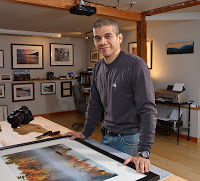
One of the pleasure of attending Photoshop World is the opportunity it provides me to sit in the presence of Jay Maisel. I've heard his presentations before and had the opportunity to study with him six years ago and he continues to inspire and inform what I hope to do with a camera.

I have the opportunity to interview Jay some years ago. Here is a link to the interview. Even if you have heard it before, it's worth listening to it again.


Here are some pearls of wisdom from one of my favorite photographers. 

"If you are not paying attention to your background, you are going to screw up anything you are trying to say with your foreground."

"Always carry your camera; it's easier to take picture that way."

"Shape is is the enemy of color."

"Here are three words for being a better photographer: 'Move your ass'"

"You only have two influences on the look of your photography: when you shoot and where you're shooting from."

"I don't believe as the dictionary says that gesture just has to do with the movement of arms and faces and legs.  I believe that gesture is involved in everything we photograph. We've all photographed gesture all our live. We just have not always been aware of it."

"Anything you do to make your image more specific, helps to make the photograph more powerful."

"Gesture will always reveal narrative, which light and color alone find it difficult to do. Gesture can tell a story."

"You cannot put your lettering in your pictures, unless you want it to be the content of your image."

"The most effective use of a pattern is when it becomes interrupted and there's a payoff in the end. Otherwise, it gets to be like wallpaper."

"You don't want to be a one-trick pony. You don't want to keep repeating yourself."

"If you can keep the element of surprise in your photography, you've already won the viewer half over."

"There is joy in ambiguity."

"There are going to be situations where you can't get yourself out of the picture. So, make yourself a part of the picture."

"I never saw light as something that casually fell on something in my picture, but rather as an integral something in my picture, like a solid object."


Ibarionex Perello & Jerod Foster at PSW

Jerod Foster and Ibarionex Perello will take the stage together today at Photoshop World in Las Vegas. They will be speaking at the Peachpit Booth at 4pm to have a candid discussion about photography, seeing and creating image using their own images as examples. If you are attending the event come on down and take part in the conversation.

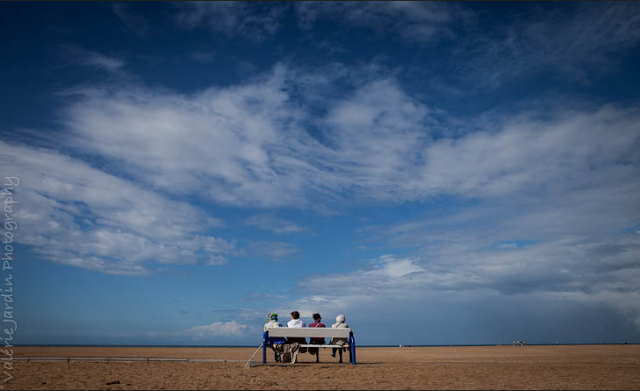
The Candid Frame #154 - Valerie Jardin

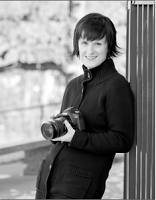
Valerie Jardin is a versatile photographer who shoots interiors and architecture where the details tell the story. She also photographs food and loves working with culinary artists on location. Portraiture work gives her the opportunity to photograph people in their environment and capture their true personality.

She also has a passion for street photography, writing and educating other photographers. Her articles appear regularly in the Digital Photography School online magazine and she teaches workshops including a street photography through the street of Paris. You can discover more about her and her work by visiting her website and blog

Valerie Jardin recommends the work of Jim Brandenburg


Click below to stream the interview.

 You can also subscribe to the show via iTunes by clicking here.

Or you can directly download the MP3 file by clicking here.

How to Keyword Your Images in Lightroom.


In this video, I demonstrate how I use keywords to organize my catalog of images. I share how I apply keywords during important and then again after making my initial selects from a shoot. This can greatly help you to be more efficient in organizing and searching for your images.


Meeting Maury Edelstein

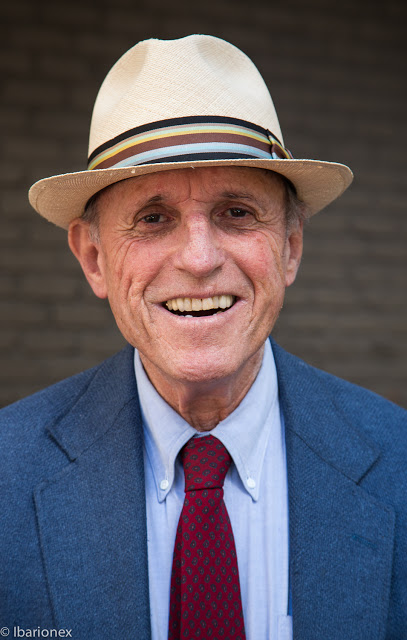
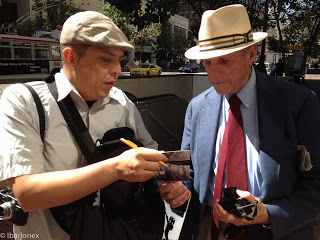
While I was in San Francisco yesterday, I spent some time shooting in the city with my friend Emilio. I was walking down Market Street when I spotted this dapper fellow making images with a small Canon camera. He was making images of a postal worker.

I struck up a conversation with him to discover that he had been photographing in this area for quite a long time and as people passed by, it seemed like he was familiar with a lot of them and they him. Visiting his website afterwards, I realized that he had accumulated a large body of work.

But what really impressed me was the wonderful energy he brought to the street. A lot of street photographers can be very earnest about their work, but he seemed to be having a lot of fun. He was really having a ball being out there in the street getting his shots. And the fact that he was doing it with such a stylus ensemble of hat, tie and shoes really impressed me.

As I told Emilio later, I could only hope that I had that much energy and enthusiasm thirty years from now.

I meet a lot of photographers on the street, but Maury definitely left me inspired.

You can check out his impressive work by visiting his website.

Accepted Photog Truths: Never Give Your Work Away


Here’s an accepted truth that litters the internet, “You should never give your work away or work for free. If you do you’re just taking the livelihood away from hard working photographers.” (1, 2, 3)

The theory behind it is solid; if every photographer stands firm and demands payment for their work, the people who need pictures will have to pay for them. Interestingly this advice is most firmly held by established, professional photographers. The argument seems to be, if you do what I say, you protect my market, and you have the potential to be as successful as me in the future. These established photographers are usually the same people that claim that amateurs have reduced their business from $200,000 a year to $40,000. They are also the ones looking for free interns to work for them and the ones that won’t give you the time of day if you’re unlucky enough to end up in a room with them when they’re commissioned to shoot the event and you’re just trying to grab a few shots. Always question the motives of people giving you advice. Does the advice benefit you or the person giving the advice?

Let’s get one thing straight, we prosumer and enthusiast photographers are not killing the market for professionals with our amateur work. The market is changing with or without us. Yes, there’s more competition in all fields. Yes, the barrier to entry has been lowered. Yes, amateurs can now shoot like professionals. No longer does owning a professional rig guarantee you professional rates.

We can easily make comparisons with changes in the music industry. Digital has changed the music industry. Obviously Napster and the MP3 had a huge effect but the cheap tools available to enthusiast musicians meant that they didn’t have to wait to be signed to a label, to get expensive studio time, to be able to make a record. Affordable digital audio interfaces (fancy soundcards to you and me), cheap and easy to use DAW (Digital Audio Workstation) software, and a plethora of information and support from their internet peers meant that anyone with a sound, an idea, a little talent and a laptop could make a record to rival releases put out by the biggest label. That bedroom, laptop jockey doesn’t have the budget of the large label to promote their work but the internet does provide a way of finding an audience for even the most niche artist. The appeal of this homemade approach reaches to a lot of established artists too which is why you hear of big artists leaving big labels to make and release their own work directly to their audience. Of course the industry is threatened. They were the gatekeepers of what got made and released and that’s no longer true. They controlled the radio stations and they no longer have as much hit-making power.

But, despite this threat and change new, innovative, entertaining music is still being created, released, listened to and, occasionally, bought. Big stars are still making big bucks. At the other end of the spectrum there are now more enthusiasts than ever making and releasing music. Those enthusiasts don’t make 100% of their income from their music; most don’t make 50% and a lot don’t make anything. A lot give their music away - they just want to be heard. A few of the artists who start out giving their music away on YouTube will make it big (Justin Bieber) but most won’t and that’s alright. Just because I give away an electronica track away for free on Soundcloud doesn’t mean that Moby is going to lose any sales of his next album and, even the likes of Moby see the value in giving some work away for free. Moby still sells records - I put my audio doodlings out there - we both get heard (admittedly by vastly differing sized audiences). The music industry has not changed because some people give their work away for free; it was changing long before that.

The photography industry won’t collapse because you allow your work to be used for free. The person who asks to use your work for free is not going to see the error of their ways because you point out how unfair it is that you don’t get paid for your work; they will just move on to the next person until they find someone who says ‘yes’. Is it shameful that for-profit publications and organizations are taking advantage of enthusiasts and are asking for work for free? Of course it is but your insistence that they treat you like Annie Leibovitz is not going to change anything. Like the music industry, the publishing industry has changed. Magazines and newspapers are folding left and right as they struggle to compete in a digital environment. Why would they commission a professional to go on assignment to illustrate something when they can search Flickr and find a dozen people with appropriate shots? One of those photographers will be flattered enough to let them use their work for free.

As a photographer you have to decide if you need financial compensation for your work to be used. But don’t think for a moment that because you give your work away some pro out there won’t eat tonight. Don’t take that on. The market has changed. If you want to let someone publish your work without payment that’s between you and your accountant or god (take your pick). You don’t want to be taken advantage of but nor should you be bullied into how you allow your work to be used.

Smugs in San Francisco Tomorrow Night

I will be in San Francisco tomorrow to make a presentation for the Smugs of San Francisco. The event runs from 6pm to 9pm and is free. You can sign up at the link below.

 The description of the presentation is as follows: Vision, Light and Refinement - three things that are key if you are interested from creating individual photographs to developing a body of work. Master Photographer, teacher, author and podcast host Ibarionex Perello will share his own journey as a photographer and how developing a deep understanding and appreciation of light helped him refine his approach to photography and create his vision. Additionally, Ibarionex will discuss how the editing process is crucial to fulfilling on that vision and truly developing a creative voice. If you are in the Bay Area tomorrow, please sign up and join us.

For more information and to register for the event click here.

The Candid Frame #153 - Robert Rodriguez Jr.


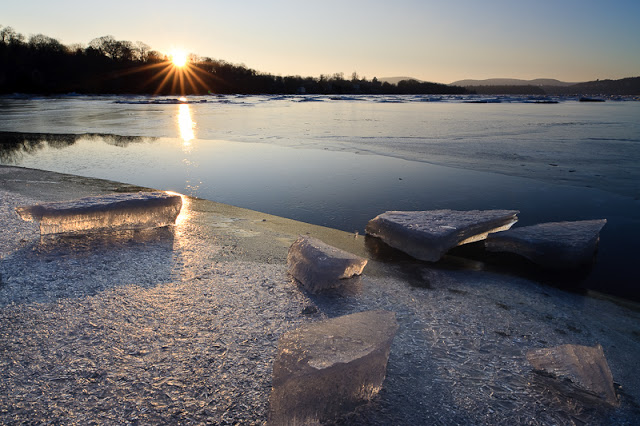
Robert Rodriguez Jr. was trained as a musician and graduated from the Berklee College of Music in 1990 and was a music producer for 12 years before transitioning to landscape photography and the desire to spend as much time in nature.

With visual story telling,  he discovered the potential to express a more creative and personal vision. Focusing on the Hudson Valley allowed Robert to discover not only beautiful landscapes often taken for granted, but the changing mood and character of the region. Seeking to capture the beauty, or convey the emotional qualities of a place or moment in nature, his images have elicited responses ranging from evocative, to spiritual and breathtaking. He frequently travels beyond in search of other dramatic and unique locations, including New England, the southwest, and Canada.

Robert takes pride in a hands on approach to creating his expressive prints, working on every stage, from the initial exposure and processing, to printing and framing. His prints have been purchased by private collectors and commercial clients throughout  North America. You can discover more about his work by visiting his website and his blog

Robert Rodriguez recommends the work of Art Wolfe.


Click below to stream the interview.

 You can also subscribe to the show via iTunes by clicking here.

Or you can directly download the MP3 files by clicking here.

5 Reasons Why Not to Become a Professional Photographer


A lof of people consider becoming a professional photographer. So, there are are no shortage of tips and suggestions for making such a leap. However, here is a list of 5 reasons you shouldn't use as impetus for going pro.

1. You hate your job. 
Being in a job that is not fulfilling and challenging is its own unique level of misery. If Dante had ever worked in a cubicle, he would have likely added another circle of Hell to his epic poem. But being in a state of misery and loathing it is not often the best state of mind for making a life change. Making a living from something you love involves making thoughtful and informed choices that will change the rest of your life. Making an impulsive choice based on such strong feelings might not result in the best decision-making, particularly when all that thinking is negative. Though your unhappiness can serve as the inspiration to make a change, it's your well-considered plan which will eventually lead you to successfully improve your professional situation.

2. You Think You'll Have More Time to Shoot 
If you are struggling finding time to shoot with your current 9 to 5, you're going to find it even more difficult when you are working 24/7 to build and sustain your fledgeling photo business. With your current role, you are responsible only for one job (regardless of how frustrating or onerous you feel about it), but there are other people at the business that handle the rest of it including accounting, sales, inventory, receptionist. All those hats end up piled on your head, meaning that you have less time to do more work. If you find time  with the job you currently have to go out and shoot, especially personal projects, you'll likely not only be able to continue this practice when you go pro, but it will likely make your free time that much more enjoyable and gratifying.

3. You Think You're Going to Become Rich
There are easier ways to become wealthy than becoming a professional photographer. Some of these even involve choices where you don't break any laws and don't risk sharing a jail cell with a guy named, "Meat". Though making a living from doing something you love can be vey gratifying, the work involved from procuring the job, creating the images, delivering the work and getting the client to pay you makes you feel like you earned every penny. The only way to achieve long-lasting success is to think of yourself as a business. And though it seems antithetical to a creative life, it's the kind of thinking that allows you rise above the tens of thousands of camera slingers who hang a sign outside of their home office and call themselves a "pro" but who only succeed in working twice as hard, but making half as much.

4. You Want to be Your Own Boss
There are definite advantages to this including someone not calling you on extending your 15 minute bathroom break. But the reality of being your own boss is that you are likely going to be the worst boss you have ever had. Now, you can't hide your oversights or omissions or your mistakes. You are ultimately accountable for everything that happens or doesn't happen. Though doing the laundry might make your signficiant other happy, it could simply be used as a distraction from the work that you really need to be doing to grow your business. Yes, your clothes may be clean and well ironed, but that will mean very little if you don't have any clients to get dressed for. If you need the fire underneath your butt to makes things happen, remember you are going to be responsible for gathering the kindling and lighting the match.

5. You're More in Love with the Idea of Being a Pro than Actually Being One
Sometimes, an unfulfilled fantasy is more gratifying than a fantasy made real. A dream manifested can be a wonderful thing, especially when it is the fulfillment of a lot of hard work. But it's the hard work that will take up the bulk of your waking hours and unless you can find that work satisfying and gratifying, you are going to have a hard time sustaining yourself between the time when you get to do what you love, making images. It's easy to get fooled by the glamour especially today in the era of the celebrity photographer, but photography is still a job, which will demand the best of you most days. That's both good and bad news.

Making the choice to go pro is giant leap of faith but the best things of life happen when you take a risk. The greater the risk of failure, the more satisfying the feeling when you succeed.

Just know where you are starting from. It really helps to figure out where you're going.

Look for Pictures That Other People Don't Make

I was talking to a friend yesterday who mentioned something that he heard the photographer, Vincent Laforet said.

"Look for pictures that other people don't make."

It's a simple statement, but one that is full of insight.

I was thinking just along these lines when during this past weekend I had some students in my Digital SLR Bootcamp make pictures of a bandshell in the park where I teach the workshop. I encouraged them to not only make photographs from eye level, but to really play around and try different perspectives, focal lengths and compositions. I asked them not to settle for just one or two photographs, but to fully exhaust all the possibilities.

Some of the resulting photographs really surprised me. I saw in their  pictures perspectives and points of view that I had never seen myself, even though it's a location that I have visited countless numbers of times. In their photographs, these students were really revealing to me the limits of my own vision.

I know what makes a good photograph or at least I think I know most of the time. So, when I photograph a scene or a subject, it's easy to compose a shot thinking that this is the definitive interpretation of it. But is that really the only possibility?

I saw photographers taking risks, making choices that they were not sure would work or not, but still committing to making the photograph. Yes, there was a risk that the image might not work, but that didn't deter them from trying it out and seeing what could happen. They weren't editing themselves and judging the picture before they made it. Instead, they practiced photography and played and discovered what worked and what didn't and in several cases, revealed exciting and beautiful surprises.

Ask 10 photographers to photograph a car and likely 9 out of 10 of them will deliver just that. They will make a picture of a car. It results in a photograph that is nothing more than  a document. Then there is the one photographer who makes a photograph not of the car, but the qualities of the car that resonate with him or her. It could be the color, the shapes, the play off light off its surface. These photographers use the camera to create from not only what they see, but what they feel.

It's so easy to compose a photograph by following all the rules. Yes, it can produce a well-composed, well-exposed photograph, but it may not surprise me or anyone else. It may not make me feel anything. It won't reveal the world to me in a different way that's both exciting and liberating.

The best photographers do that and it begins when they make photographs that other people aren't making.

It's about photographing the world that expresses not only how I uniquely see it, but also which reveals my exploration of that world when I make non-traditional choices with the camera. When I am willing to take the risk and do something different, even though there is a possibility that it may not work, is whenI am really living in the spirit of what it means to be a photographer.

Photo Quote of the Week

I think the equipment you use has a real, visible influence on the character of your photography. You're going to work differently, and make different kinds of pictures, if you have to set up a view camera on a tripod than if you're Lee Friedlander with handheld 35 mm rangefinder. But fundamentally, vision is not about which camera or how many megapixels you have, it's about what you find important. It's all about ideas. - Keith Carter (from PhotoQuotes.com)

The Danger of Knowing Too Much

Once you learn to deconstruct music
you'll never listen to it the same way again.
Photography, more than any other art form I know, is the perfect blend of technical knowledge meeting artistic expression to create visual magic. At least that's what I tell myself. The truth is less than perfect. The perfect balance is so hard to achieve with most photographers skewing too hard to one side or other of the balance point.

Here on the Candid Frame we often bemoan the fact that so much content out there is purely technical and about cameras and technique and not about photography. Photography disproportionately attracts a certain demographic; middle-aged, middle-class guys - my peeps. We have a tendency to pull the conversation towards the technical. In our defense, it has a lot to do with the way we were brought up and educated: we were pushed more towards the sciences, engineering and mathematics. We were encouraged to pull things apart and build things, to look at how things work, to be deconstructionists. Who can blame us when we apply the same philosophy to everything in the world: to people, relationships, to our art.

I noticed this early on in my own artistic endeavors. As a teenager and early twenty-something my passion in addition to partying and photography, was music. I loved listening to music and seeing bands play live so, naturally, I wanted to play in bands myself. To be in a band back then you had to be a deconstructionist. When you joined a band you'd be given a cassette tape of the band's material and you'd go away and spend a few weeks learning your part. This meant sitting with your instrument and a tape deck in your bedroom and tuning in to your part in each song, learning it by heart and playing along. It changes the way you listen to music forever. As a consumer of music you listen to music as a whole thing - you let the music wash over you and transport you. This is listening to music the way the musicians intended. As a wannabe musician you learn to pull the music apart in your head; to listen to the bass, the drums, vocal, keys and guitars all separately. You learn to tear it apart into measures of verse, chorus, intro, outro, bridge and solo and even more granular elements. You learn to find the key changes and the appropriate scales to use to build your solo from. You sit for hours listening to recordings of your heroes learning something note for note. When you have had enough of emulating others you try to build your own songs but you can never hear them like your audience can. You listen to your part and your band-mate's parts and any mistake or imperfection that you hear pulls your ear away from the whole.

When I got into video and filmmaking it was the same process. You take this thing that you love and you learn how to pull it apart into its components so that you can build it yourself. You learn too much to really enjoy your own work or the work of others anymore. There's a musicians joke that sums this up: How many guitarists does it take to screw in a light-bulb? Four. One to change the bulb and three to stand around mumbling to each other, 'I can do that better.'

There is still mystery and magic to be found in holy places.
The danger in attempting any art-form is that you will lose the magic in the experience that attracted you to that thing in the first place. It can be a high price to pay. In order to participate, you can't experience the art the same way as you audience ever again. Getting back to photography, I feel like the move to digital accelerated my understanding of the mechanics of photography so much faster than I had been able to achieve in the analog medium. Back in my film days I could get a decent exposure but I didn't understand the mechanics of exposure intimately until I moved to digital. Digital's instant feedback and the ability to experiment without additional cost made me technically a better photographer and I could now control exposure rather than just getting by but did this technical knowledge stop me from experiencing the magic of photography in the same way? Of course it is too easy to slip into nostalgia for the film days. The experience of being in a chemical darkroom and seeing an image slowly materialize before your eyes was so other-worldy and magical it captured our imaginations for a lifetime. The distance you got between exposing a frame and seeing a print was like a tiny jump back in time. In the digital darkroom everything is instantaneous and infinitely, minutely adjustable. You don't need to set hours aside to go there and the slow emergence of a print line by line inspires only impatience and frustration and not awe.

And yet I'd never go back; we can't go back. I love digital because it has made me a better photographer. I look back at my wet prints and all I see is dust and scratches and bad exposures and poor materials and mistakes. That is the price we pay for knowledge. So how can you experience the magic again? In music I can get it from forms I never learned to deconstruct: jazz, electronica and hip-hop. In film I find it in foreign movies that don't have to follow the Hollywood formula or short films or movies made for no money that don't have backers they have to answer to. In photography I find it by removing myself from the digital experience: by really spending time looking at monographs and by visiting my holy places, museums and galleries, where pictures transport you beyond the technical into the imagination and experience of the photographer.

There is no way to unknow what you know, or to turn it off. That boat has sailed. But in acknowledging your knowledge you can still find ways to experience the magic of photography. It is that magic I try to draw upon for inspiration not a newly learned technique or newly acquired piece of gear. It is so much easier for many of us to fall back on technique but, in my opinion, it is worth the effort to work harder to try to rekindle the magic that inspired you in the first place.

I'd love to hear any opinions you might have on this subject in the comments below.   

The Candid Frame #152 - Brian Matiash


Brian Matiash is a professional photographer as well as the Education Manager for OnOne Software. In his role as an educator, he teaches photographers how to improve their photographs and their editing skills with his many webinars, articles and blog entries, but he also has his own passion for photography.

He has specialized in developing and refining his use of HDR (High-Dynamic Range)  to use it not merely as a gimmicky visual effect, but rather as a tool to help him realize his own personal vision of a subject and a scene. You can find our more about Brian and his photography by visiting his website and his blog.

To read his guest blog entry on Scott Kelby's blog click here.

Brian Matiash recommends the work of Nicole Young.

For streaming audio click here or subscribe to the podcast for free viaSubscribe via iTunes

How to Edit Your Travel Photos

Here is a short video in which I demonstrate how I use Adobe Lightroom to edit down thousands of images from my recent vacation. Using rankings, collections and the Compare view, I demonstrate how to create a more manageable collection of images that best capture the story behind my travels.

This is a technique which I use not only for winnowing down images from my travels, but also large bodies of work including personal projects.

If you like these videos, please subscribe to the YouTube channel for future releases.